What is knee osteoarthritis?
Knee osteoarthritis (arthritis of the knee, gonarthrosis) means that the smooth cartilage covering the joint surfaces gradually becomes thinner and breaks down. It is often called wear and tear.
As the cartilage thins, the bone underneath takes more load. Bony growths (bone spurs, or osteophytes) form at the edges of the joint, and the joint lining can become inflamed, so fluid may build up in the knee. This process develops slowly over years. How much pain you feel does not always match what the X-ray shows.
What causes it and who gets it?
The main risk factors are age, excess weight, being female and a family tendency. Earlier meniscus or ligament injuries, removal of a meniscus, fractures into the joint and leg alignment problems (bow legs or knock knees) can speed up osteoarthritis. Heavy physical work and squatting for long periods also increase the load on the knee.
What are the symptoms and stages?
At first, pain appears after long walks, using stairs and squatting. You may feel stiff for the first steps in the morning or after sitting for a long time. As the condition progresses, pain is also felt at rest and at night. The knee may swell, may not straighten or bend fully, and the leg may become more bowed.
On X-rays, knee osteoarthritis is usually graded in four stages:
- Stage 1 (doubtful): very mild changes; the joint space is preserved.
- Stage 2 (mild): small bone spurs and slight narrowing of the joint space.
- Stage 3 (moderate): clear narrowing and several bone spurs.
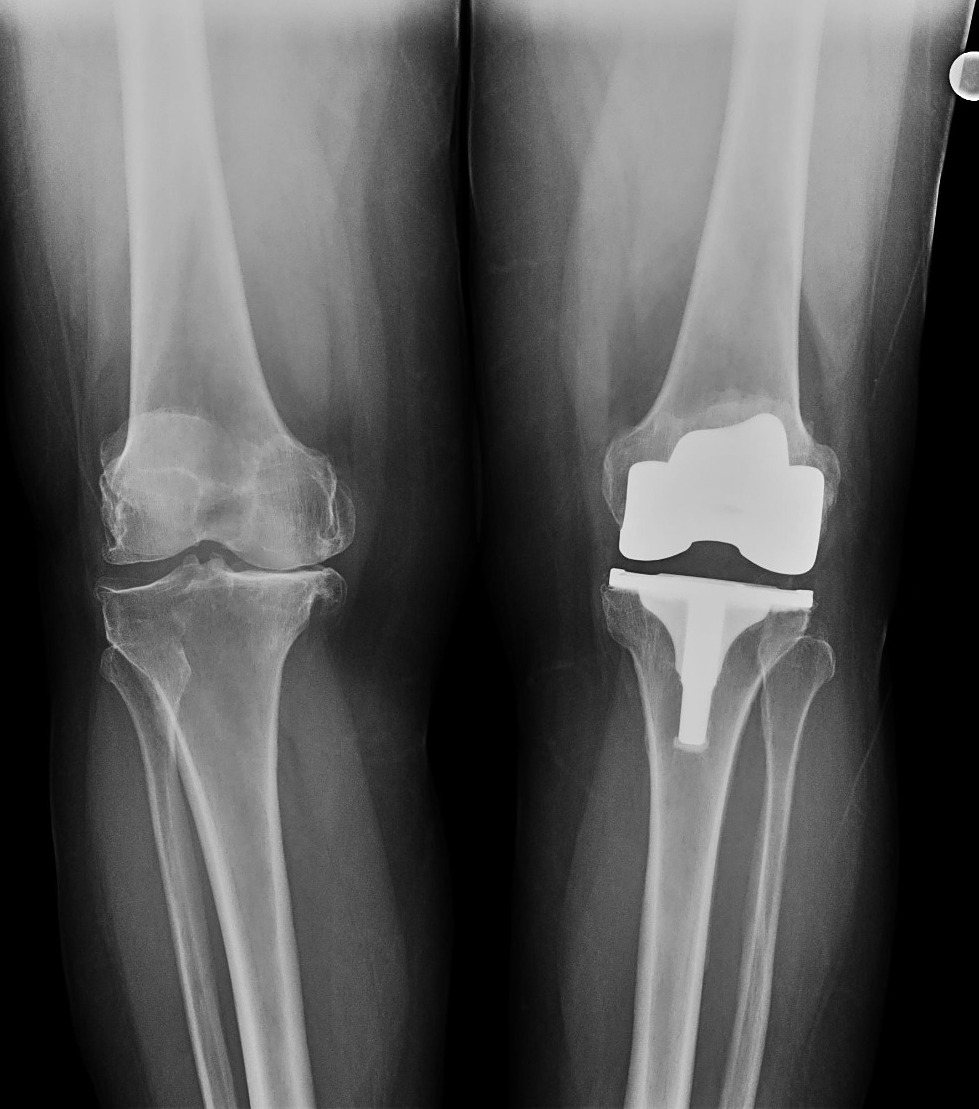
- Stage 4 (severe): the joint space has largely closed, with bone touching bone and a change in shape.
How is it diagnosed?
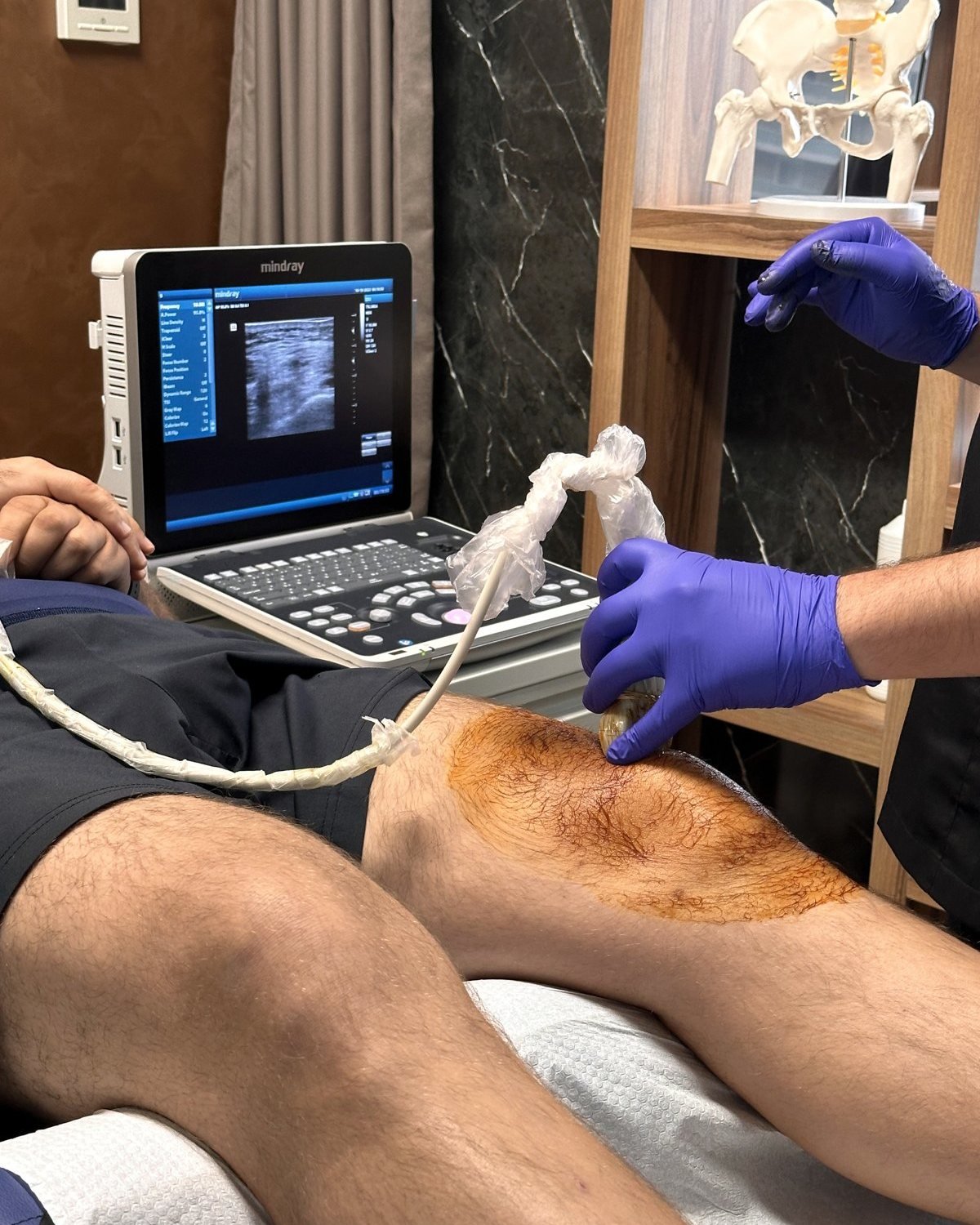
During the examination we check how far your knee moves, whether there is fluid in the joint, where the pain is and how your leg is aligned. An X-ray of the knee taken while you stand shows the stage of osteoarthritis. With ultrasound we can see fluid in the joint, inflammation of the joint lining and a cyst at the back of the knee (Baker's cyst) in the same appointment.
Not every patient needs an MRI scan. We ask for one if the knee suddenly starts to lock, if a new tear is suspected or if the pain cannot be explained by the X-ray.
What are the non-surgical treatment options?
Losing weight directly reduces the load your knee carries. Even a loss of a few kilograms can make a difference to pain on stairs and when walking. Regular exercise that strengthens the front thigh muscle (quadriceps) and the hip muscles is the basis of treatment at every stage. The physiotherapist prepares a programme that does not strain your knee.
Joint injections are given under ultrasound guidance. If fluid has built up in the knee, it is drained first. A steroid (cortisone) injection can give short-term relief in a flared-up, swollen and inflamed knee, but frequent repeats are not recommended. Hyaluronic acid (a lubricating gel similar to joint fluid) and PRP (platelet-rich plasma, prepared from your own blood) can be used, especially in mild and moderate stages, to reduce pain and make it easier to return to exercise.
Genicular nerve radiofrequency ablation is radiofrequency treatment of the small nerves that carry pain from the knee. The nerves are found with a needle under ultrasound guidance and treated with radiofrequency current. No cut is made, and it is done under local anaesthetic. It is an option for people with moderate to severe osteoarthritis who do not want surgery, whose other health conditions make surgery risky, or for whom a knee replacement seems too early. It aims to give relief that can last for months. Radiofrequency treatment does not repair cartilage. It aims to reduce pain so that you can exercise.
When is a knee replacement needed?
In a knee replacement, the worn joint surfaces are covered with metal and special plastic parts. It is considered when pain disturbs your sleep, the distance you can walk has become much shorter, the leg is becoming more bowed and the X-ray shows severe osteoarthritis. The decision is not based on the X-ray alone. We make it together, based on your quality of life and your expectations.
If osteoarthritis affects only the inner or outer part of the knee, a partial knee replacement may be an option. In younger patients with a bowed leg, an osteotomy may be an option: an operation that realigns the bone to shift the load to the healthy side. After surgery, Dr Gürsel and the physiotherapist follow your recovery together.
When should I see a doctor?
We recommend an examination if your knee pain has lasted for a few weeks, if it limits daily activities such as stairs, walking and getting up, or if your knee keeps swelling.
Seek medical care on the same day if your knee suddenly becomes red and warm and you have a fever, as this can be a sign of a joint infection.

Reviewed by Dr Enis Gürsel, Orthopaedic and Trauma Surgeon · Last reviewed: 5 November 2026