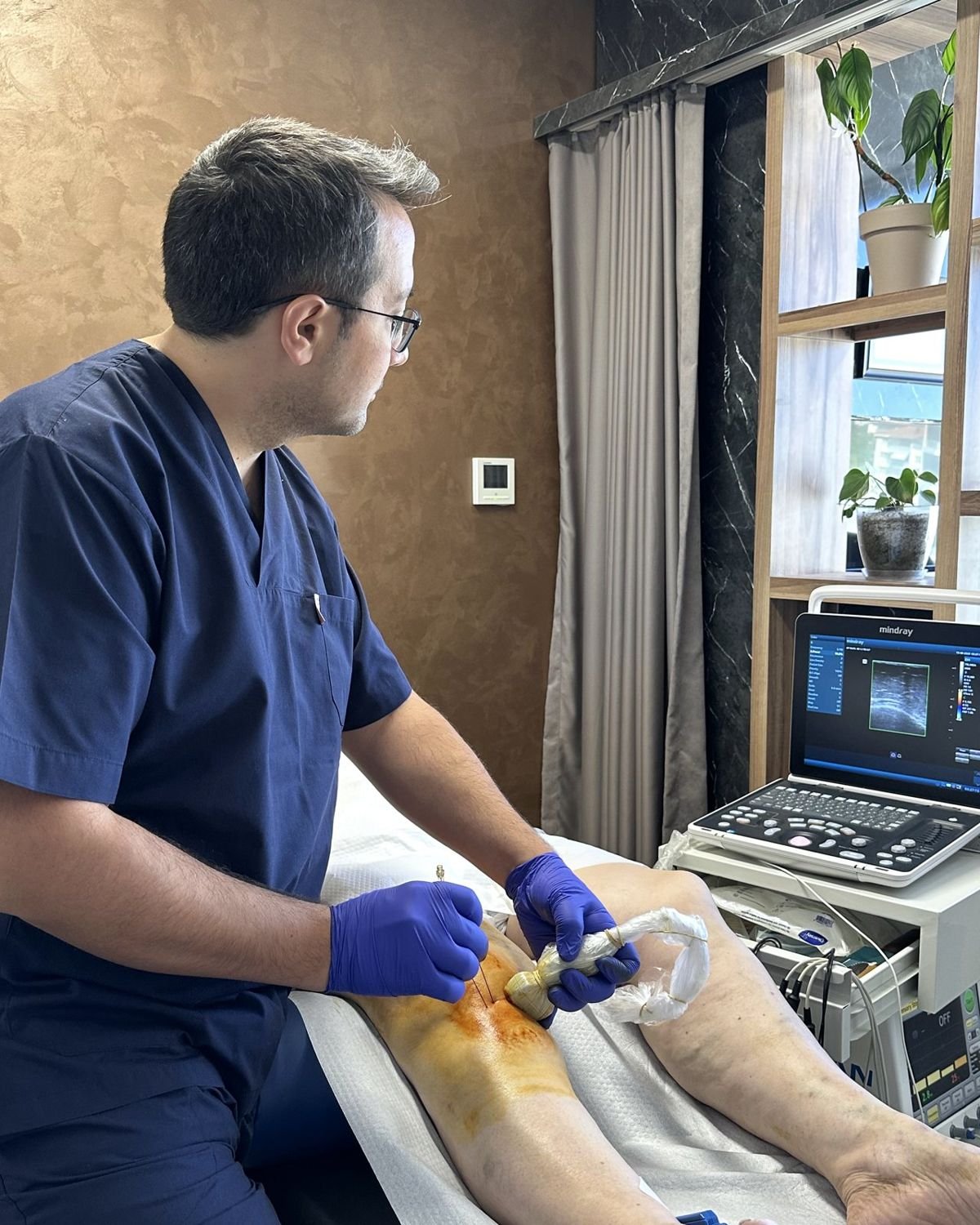
What does ultrasound guidance mean?
Ultrasound uses sound waves to show muscles, tendons, joints and nerves in real time. It does not use radiation.
During the injection, we see the needle on the screen and guide it to the target tissue. This helps the medicine reach the place where it needs to go. On the same image we can also see nerves and blood vessels along the way, and we plan the path of the needle around them. This helps us carry out the procedure in a more controlled way.
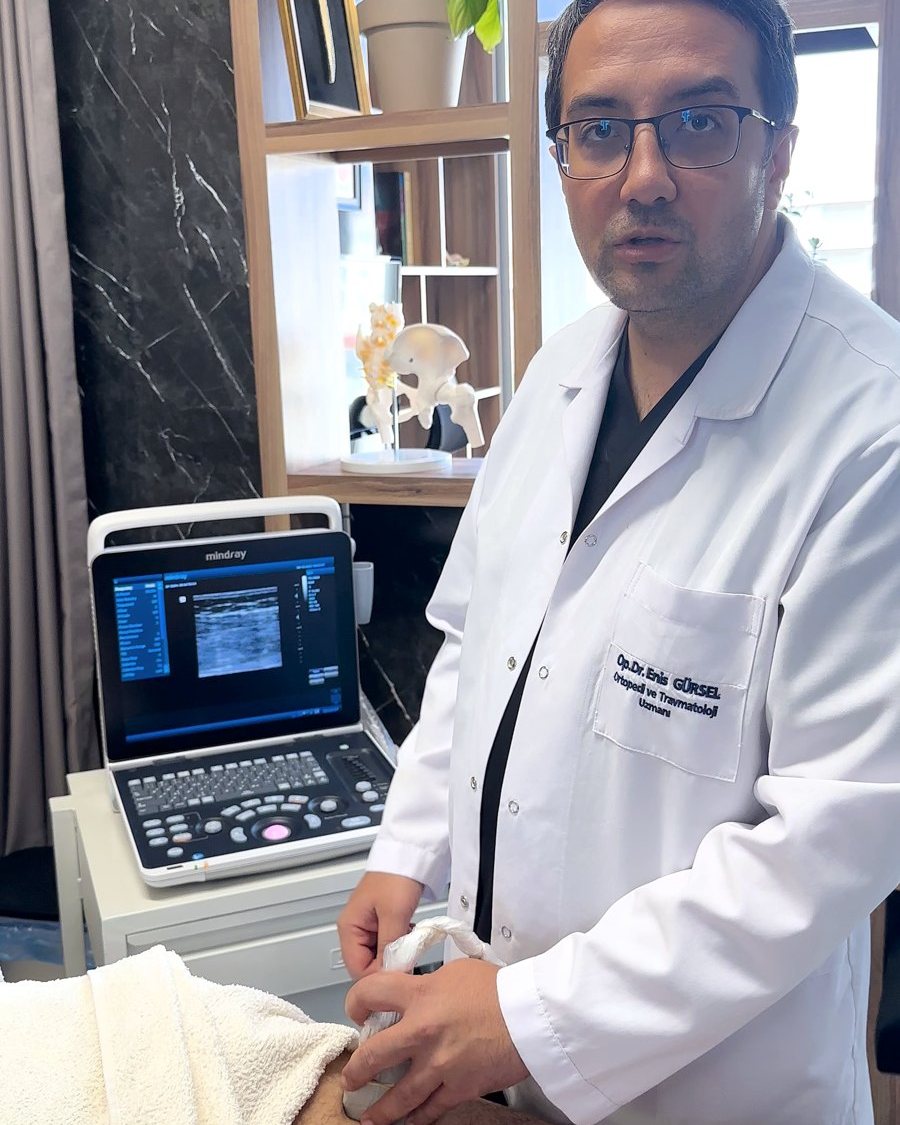
We look first, then decide
We do not use ultrasound only to guide the needle. We also use it to check the area just before the procedure. For example, if we see fluid collected in the knee (joint effusion), we drain this fluid first and then give the planned medicine. If we see something unexpected, we rethink the treatment on the day.
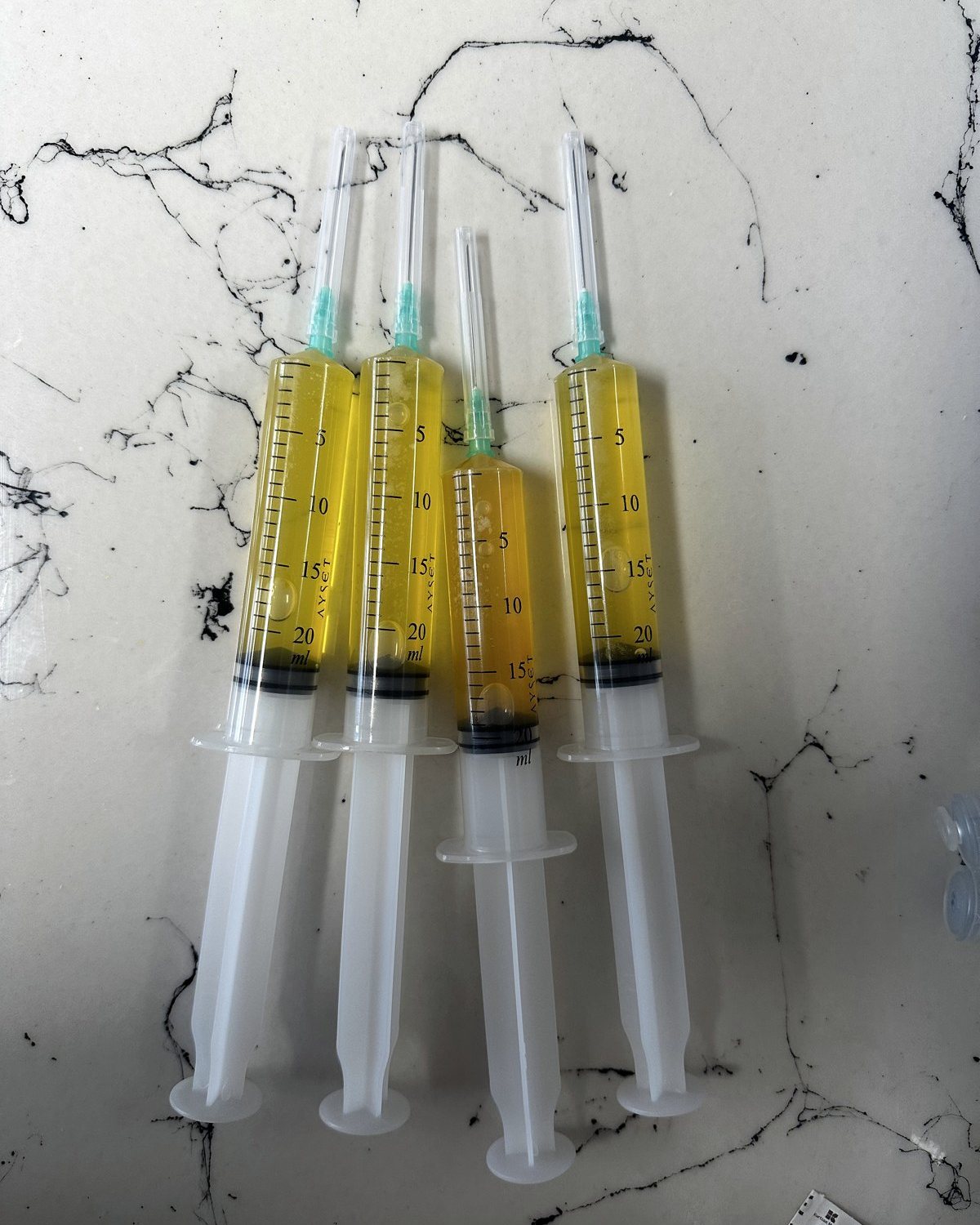
Which injections do we give?
The right choice depends on your problem, your examination and your scan. These are the main types:
- Steroid (cortisone) injection: aims to give quick relief when a joint or tendon sheath is clearly inflamed and swollen. It is not repeated often in the same place, and we do not give it into or around the Achilles tendon.
- Hyaluronic acid injection (sometimes called a lubricating or gel injection): supports the joint fluid, usually in mild to moderate knee osteoarthritis. Relief, if it comes, usually appears over a few weeks rather than straight away.
- PRP (platelet-rich plasma) injection: made from a small sample of your own blood, spun in a centrifuge to concentrate the platelets. It can be given into a joint, a tendon or a muscle.
- Combined PRP and hyaluronic acid injection: PRP is mixed with hyaluronic acid in a special tube and given as one injection into the joint. Only a blood sample from your arm is needed, and it can be done at the clinic. Research on this combination is limited and long-term results are not yet clear.
- Injection of your own fat tissue (often called a stem cell injection): described in its own section below.
Where can injections be given?
- Joints: knee, shoulder, hip and ankle, for osteoarthritis, joint inflammation and repeated fluid in the knee. The hip is a deep joint, so ultrasound is especially helpful there.
- Tendons and tendon sheaths: tennis elbow, de Quervain's (pain at the base of the thumb), trigger finger and pain around the Achilles tendon. We inject around the tendon and into its sheath, not into the tendon itself. For persistent Achilles tendon pain we can give a steroid-free high-volume injection: saline and local anaesthetic are injected around the tendon, not into it.
- Muscle tears: in athletes, we can drain collected blood (a haematoma) and, in selected tears, give PRP. Rehabilitation then prepares you for return to sport.
- Trapped nerves: for carpal tunnel syndrome (a trapped nerve in the wrist that causes numbness in the hand) and similar problems, we inject around the nerve and use hydrodissection (fluid injected to separate the nerve from the tissue around it).
What is an injection of your own fat tissue?
This treatment is often called a stem cell injection. A small amount of fat is taken from your abdomen or hip area, processed in the same session and injected into the joint. The cells are not grown in a laboratory.
We do this in the operating theatre, under sterile conditions and under sedation (you are drowsy but not fully asleep). For the knee we use ultrasound, and for deeper joints such as the hip we use X-ray imaging in the operating theatre.
It is usually considered for mild to moderate knee osteoarthritis. It has not been shown to rebuild cartilage, and it does not replace a joint replacement in advanced osteoarthritis. We explain clearly what is known and what is still being researched.
Who are injections for?
An injection is not right for everyone. After the examination, physiotherapy, medicines, radiofrequency treatment or surgery may be more suitable for you. If surgery is needed, we plan it without delay.
An injection is postponed if there is a skin infection in the area, a suspected joint infection or poorly controlled blood sugar. In advanced osteoarthritis that clearly limits daily life, a joint replacement may be a better option. We make this decision together.
What is the visit like?
You do not need to fast. If you take blood-thinning medicines, please tell us in advance. If you have had marked swelling after an injection before, tell us too.
We clean the skin, use local anaesthetic if needed and move the needle forward while watching it on the ultrasound screen. Most procedures take 15–45 minutes, depending on the type of injection. You go home the same day, and after most injections you can walk out of the clinic.
For a day or two, avoid straining the area. For hip or right knee injections, it may be more comfortable to come with someone who can drive you home.
Possible risks and side effects
After an injection, the pain may increase for 24–48 hours. Infection, bleeding and nerve damage are rare risks. We work under sterile conditions and use ultrasound to reduce these risks.
A steroid injection can raise blood sugar for a few days in people with diabetes, and can cause facial flushing and a feeling of warmth. When given close to the skin, it can cause lighter skin colour or a small dip in the skin. After an injection of your own fat tissue, bruising, swelling and tenderness where the fat was taken are common for a few days.
After the injection: physiotherapy and follow-up
An injection is one part of treatment, not the whole of it. When the pain eases, strengthening exercises are the main step that protects the joint or tendon. Our physiotherapist, Gökçenaz Arpaçay, plans a programme that suits you, and we check your response at a follow-up appointment.

Reviewed by Dr Enis Gürsel, Orthopaedic and Trauma Surgeon · Last reviewed: 5 November 2026