What are tennis elbow and golfer's elbow?
Tennis elbow (lateral epicondylitis) is wear of the tendons that attach to the bony bump on the outside of the elbow. This is the shared tendon of the muscles that lift your wrist and fingers.
Golfer's elbow (medial epicondylitis) is wear of the tendons on the inside of the elbow. It affects the tendon of the muscles that bend your wrist and fingers.
In both, the tendon cannot adapt well enough to repeated load, and the structure of the tissue changes. For this reason the term tendinopathy (wear of a tendon from overuse) is more accurate than tendinitis, which suggests inflammation.
What causes it, and who gets it?
It is most common between the ages of 35 and 55. Common triggers include long hours with a computer mouse and keyboard, and working with tools such as screwdrivers, hammers and scissors. Carrying heavy bags, gardening, knitting, cleaning and carrying a baby can also cause it.
In racket sports, poor technique or the wrong grip can lead to tennis elbow. Golf, throwing sports and weight training can lead to golfer's elbow. Smoking and being overweight also increase the risk.
What are the symptoms?
- Pain over the bony bump on the outside or inside of the elbow, which gets worse when you press on it
- Pain when you lift a cup, a kettle or a shopping bag, or turn a door handle
- A feeling of weakness when you shake hands or grip something
- Pain that spreads down the forearm
- In golfer's elbow, sometimes numbness in the little and ring fingers, because the nearby ulnar nerve is affected
How is it diagnosed?
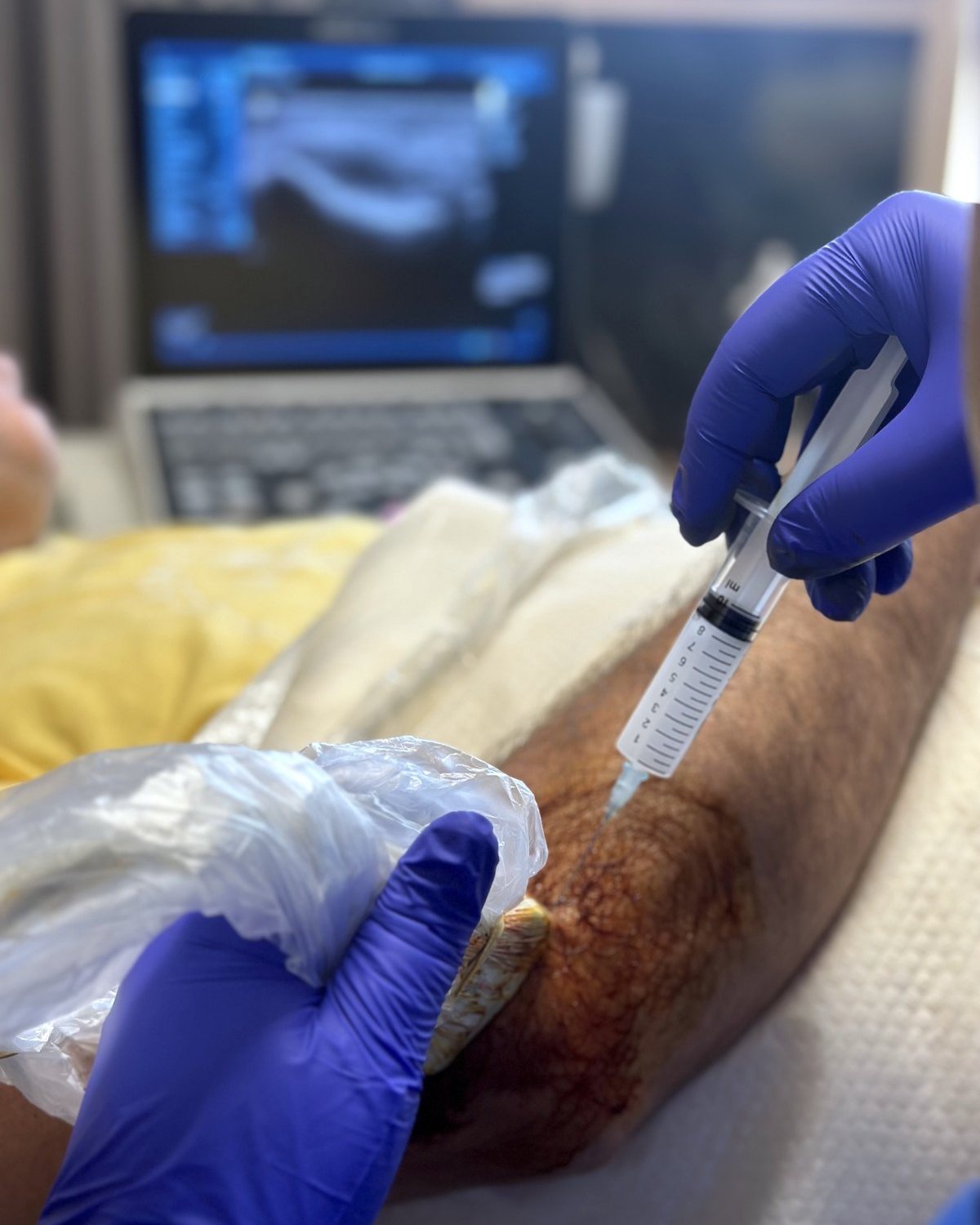
The diagnosis is usually made by examination. Typical signs are pain at a specific spot, and pain when you lift or bend your wrist against resistance. At our clinic we also use ultrasound in the same appointment. It shows thickening of the tendon, changes in its structure and any partial tears.
A slipped disc in the neck, arthritis in the elbow joint or a trapped nerve in the forearm can cause similar pain. If we suspect one of these, we may ask for an X-ray, or less often an MRI scan or a nerve conduction test (EMG).
How is it treated?
Tennis elbow and golfer's elbow tend to get better on their own over time, but this can take months. The aim of treatment is to make this period shorter and less painful.
Managing the load on the tendon is the first step. You do not need to stop the movements that cause pain completely, but you adjust how much you do them. Small changes make a difference: lift heavy things with your palm facing up, use tools with thicker handles, and change your computer set-up. An elbow strap worn on the forearm (epicondylitis brace) or a wrist support can reduce the load on the tendon and make daily tasks easier.
The core of physiotherapy is exercise that gradually makes the tendon strong again. Our physiotherapist, Gökçenaz Arpaçay, starts with static (isometric) exercises that reduce pain. Then she moves on to eccentric exercises (where the muscle works while it lengthens) and strengthening exercises.
In persistent cases, an ultrasound-guided injection is an option. A steroid injection can give relief quickly. However, repeated steroid injections can weaken the tendon and make it more likely that the pain comes back, so we use them only in a limited number of selected patients. PRP (platelet-rich plasma, prepared from your own blood) is injected into the damaged area under ultrasound guidance to support the healing process of the tendon. Shock wave therapy is another option.
In a small number of people, the pain does not improve after months of appropriate treatment. For them, surgery to remove the damaged tendon tissue may be considered.
When should I see a doctor?
We recommend a consultation if your elbow pain has lasted for a few weeks or limits your work or daily life.
Do not wait if your elbow is swollen and hard to move after a fall, because a fracture needs to be ruled out. Also see a doctor without delay if you have clear numbness or weakness in your fingers, as this can be a sign of a trapped nerve.

Reviewed by Dr Enis Gürsel, Orthopaedic and Trauma Surgeon · Last reviewed: 5 November 2026