What are shoulder impingement and the rotator cuff?
The rotator cuff is made of the tendons of four muscles. They run from the shoulder blade to the top of the arm bone. They let you lift and rotate your arm, and they hold the ball of the arm bone in its socket.
Above these tendons, under a bony roof called the acromion, there is a small fluid-filled sac (bursa). It reduces friction when you move.
When you lift your arm, the tendons and the bursa can be squeezed under this bony roof and become irritated. This is called shoulder impingement (subacromial impingement). Over time the tendon can wear (tendinopathy), and a partial or full-thickness tear can develop.
What causes it, and who gets it?
- Age-related wear of the tendon, usually after the age of 40
- Jobs where you often work with your arms above your head, such as painting or construction
- Throwing and overhead sports, such as swimming, volleyball and tennis
- Weak shoulder blade muscles and a rounded, slouched posture
- A fall or suddenly lifting a heavy load (a sudden tear in younger people)
What are the symptoms?
- Pain at a certain angle when you lift your arm to the side or to the front
- Pain on the outer side of the shoulder that spreads down the arm
- Pain at night that wakes you when you lie on the painful shoulder
- Difficulty combing your hair, putting on a jacket or reaching into your back pocket
- Weakness when lifting the arm as a tear gets bigger
How is it diagnosed?
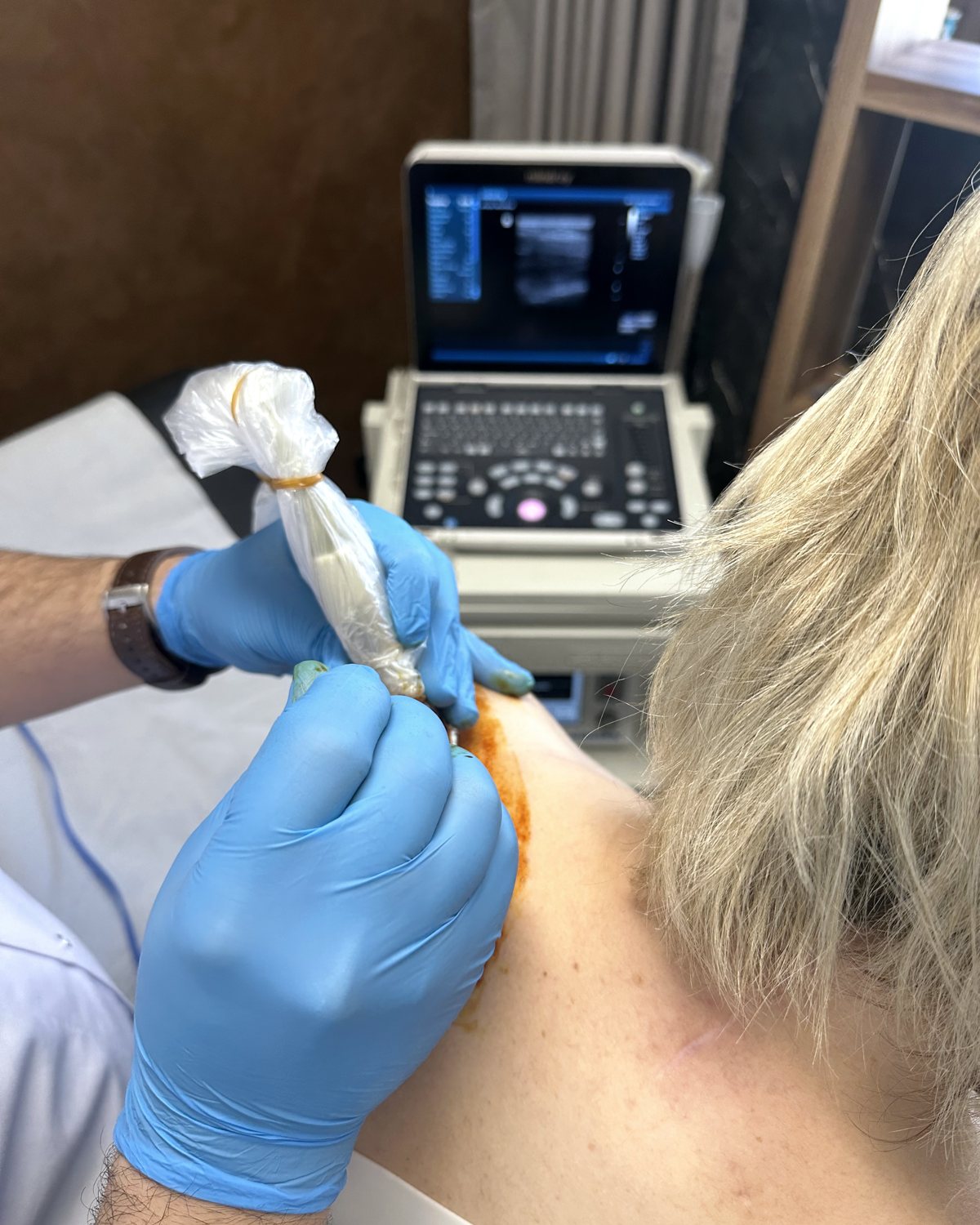
During the examination we check how far your shoulder moves, the strength of each tendon and specific impingement tests. With ultrasound we can see the tendons and the bursa while your shoulder moves. This usually shows in the same appointment whether there is a tear.
An X-ray shows the shape of the bony roof and any arthritis. If we suspect a full-thickness tear, or if surgery is being planned, we ask for an MRI scan. A problem in the neck, such as a slipped disc in the neck, can also cause pain that spreads to the shoulder, so we examine your neck as well.
How is it treated?
For impingement and tendon wear, exercise is the basis of treatment. Our physiotherapist, Gökçenaz Arpaçay, takes you through a programme that strengthens the rotator cuff and shoulder blade muscles and improves your posture. A short break from the movements that cause pain also helps.
If the pain is too strong for you to exercise, we give an ultrasound-guided injection into the bursa (subacromial bursa). The medicine goes into the bursa around the tendon, not into the tendon itself. For selected tendon problems, PRP (platelet-rich plasma, prepared from your own blood) can also be an option.
Some people have mainly night pain and are not suitable for surgery. For them, a suprascapular nerve block may be used to reduce the pain. This means we use ultrasound to numb the nerve that carries feeling from the shoulder.
Surgery is planned for full-thickness tears caused by an injury in young and active people, for tears that cause weakness or are getting bigger, and when symptoms continue despite appropriate treatment. In arthroscopic rotator cuff repair (keyhole surgery), the tendon is stitched back to the bone through small cuts, using a camera and small anchors placed in the bone. Surgery that only shaves the bony roof to treat impingement is now used more selectively.
Recovery after surgery and possible risks
After a rotator cuff repair, your arm is usually kept in a sling for 4–6 weeks. Rehabilitation starts with gentle passive movements, guided by the physiotherapist. You then move on to active movement and strengthening. Returning to heavy work and overhead sports takes several months and is different for each person.
Possible risks include infection, stiffness of the shoulder and the tendon tearing again. After an injection, the pain can increase for 24–48 hours.
How can I protect my shoulder in daily life?
- Take breaks from work that keeps your arm above shoulder height for a long time.
- Carry loads close to your body, and do not lift heavy things with your arm stretched out.
- Do not lie on the painful shoulder at night. A pillow under your arm can help.
- At a desk, do not let your shoulders drop forward, and set your screen at eye level.
- Do not stop your exercises when the pain eases. Keeping them up helps reduce the chance of the problem coming back.
Other shoulder problems with similar symptoms
Shoulder pain is not always caused by impingement or a tear. Frozen shoulder (adhesive capsulitis), where the shoulder becomes stiff in every direction, needs different treatment. So do calcium deposits in a tendon (calcific tendinopathy), which can cause sudden severe pain, and osteoarthritis of the shoulder joint. The examination helps us tell these apart.

Reviewed by Dr Enis Gürsel, Orthopaedic and Trauma Surgeon · Last reviewed: 5 November 2026