What is Achilles tendon pain?
The Achilles tendon connects the calf muscles to the heel bone. It is the thickest and strongest tendon in the body.
Achilles tendinopathy (wear of the tendon from overload) develops when the tendon takes more load than it can handle and repair cannot keep up. People often call it Achilles tendinitis or inflammation of the Achilles. In fact, the problem is less about inflammation and more about changes in the structure of the tendon tissue.
There are two types, and the type decides the treatment:
- Mid-portion tendinopathy: the pain and thickening are a few centimetres above the heel. It is more common in runners and active people.
- Insertional tendinopathy: the pain is where the tendon attaches to the heel bone. There may also be a bony bump at the back of the heel (Haglund's deformity) and inflammation of the small sac in front of the tendon (retrocalcaneal bursitis). Rubbing from the back of the shoe makes the pain worse.
What causes it, and who gets it?
The most common triggers are increasing your running distance or speed too quickly, hill and stair training, hard surfaces and a change of shoes. Being overweight, weak or tight calf muscles, diabetes and high cholesterol also increase the risk.
Some antibiotics (the quinolone group) and long-term use of steroid medicines can weaken the tendon. If you start to have pain in the Achilles area while taking these medicines, tell your doctor.
What are the symptoms?
- Stiffness and pain at the back of the heel in the first steps in the morning or after sitting for a long time
- Pain at the start of activity that eases as you warm up, then gets worse after activity or the next day
- Thickening or swelling of the tendon, or tenderness when you press on it
- In the insertional type, a bump at the back of the heel and pain that gets worse when the shoe rubs
How is it diagnosed?
During the examination we check where the pain is, how thick the tendon is and how strong your calf muscles are. With ultrasound, in the same appointment, we can see thickening of the tendon, changes in its structure, new blood vessels, partial tears and an inflamed bursa.
For the insertional type, we take an X-ray to look for a bony bump on the heel bone and calcium deposits in the tendon. An MRI scan is planned if we suspect a tear or if the pain does not respond to treatment.
How is it treated?
Treatment is not about resting the tendon completely. It is about getting the load right and making the tendon strong again, step by step. For a while, you reduce activities that clearly make the pain worse, such as running, jumping and walking uphill. You carry on with daily activities as far as the pain allows.
Eccentric exercises (slowly lowering yourself from tiptoe, so the calf muscle works while it lengthens) and heavy, slow strength exercises have the strongest research support. For the mid-portion type, you can do these on the edge of a step. For the insertional type, you do them on flat ground without letting the heel drop below the step, because lowering the heel increases pressure on the attachment. Any effect of this programme usually appears over weeks, and it needs patience and regular practice. A heel raise for a while and suitable shoes also support treatment.
Extracorporeal shock wave therapy (sound waves directed through the skin to the tendon) can be an option if the pain does not improve with exercise.
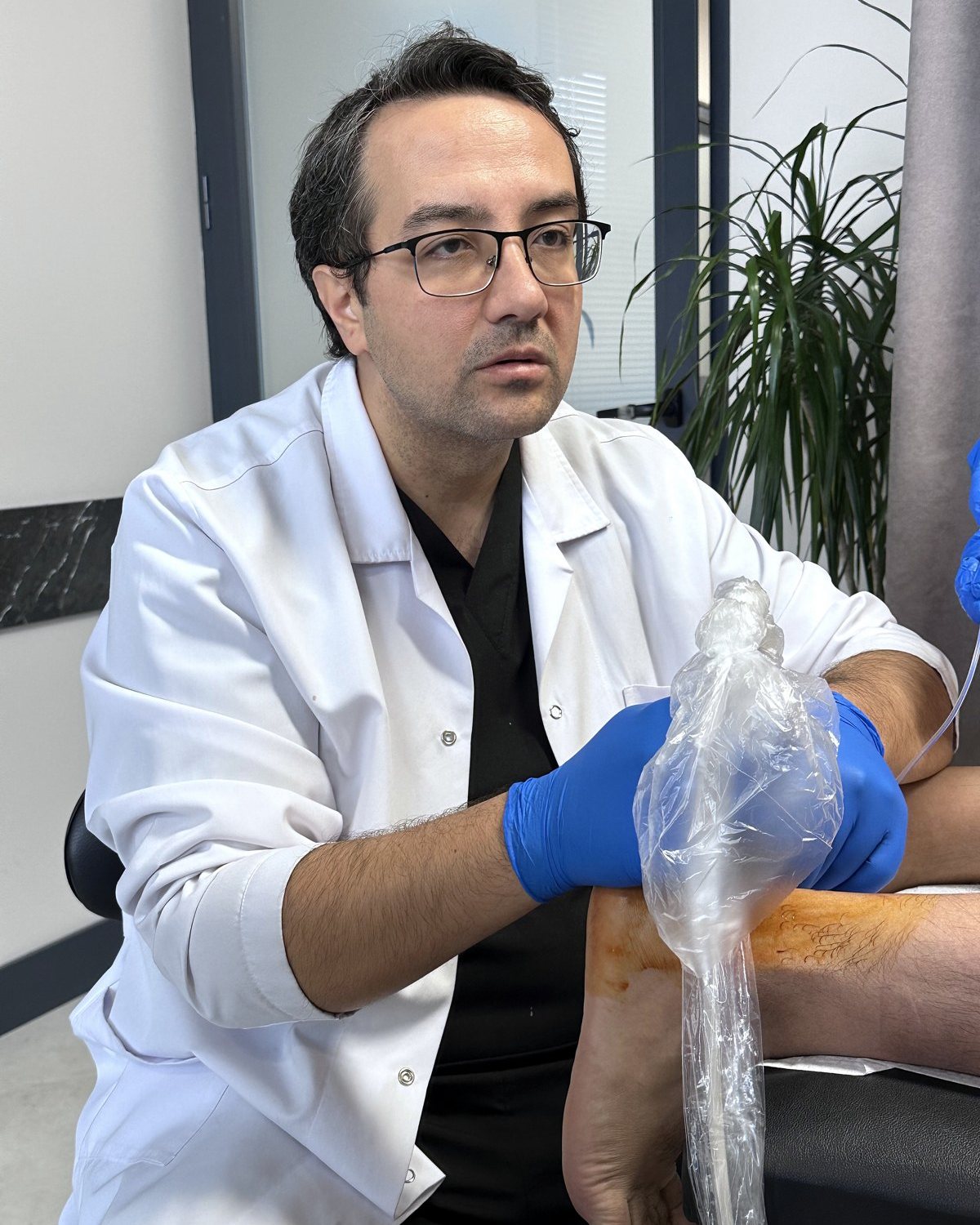
For persistent mid-portion tendinopathy, we can give an ultrasound-guided high-volume injection. Saline and local anaesthetic are injected outside the tendon, into the tissue on its front surface where new blood vessels and pain nerves are found. We do not give steroid (cortisone) injections into or around the Achilles tendon, because steroids can weaken the tendon and increase the risk of it tearing. In suitable patients, PRP may also be considered.
Surgery may be considered if the pain does not improve after months of appropriate treatment. This is especially the case for the insertional type with a large bony bump. The operation removes the damaged tissue and the bony bump.
When should I see a doctor?
We recommend a consultation if the pain at the back of your heel has lasted for a few weeks or limits your sport.
Do not wait if you think your Achilles tendon may be torn (ruptured). Signs include a sudden feeling as if someone has kicked you or hit you with a stone at the back of your calf, sometimes with a snapping sound. Afterwards you cannot stand on tiptoe and you limp. In this case you need to be seen the same day. Having little pain and being able to walk does not rule out a tear. An early diagnosis keeps more treatment options open.
Reviewed by Dr Enis Gürsel, Orthopaedic and Trauma Surgeon · Last reviewed: 5 November 2026